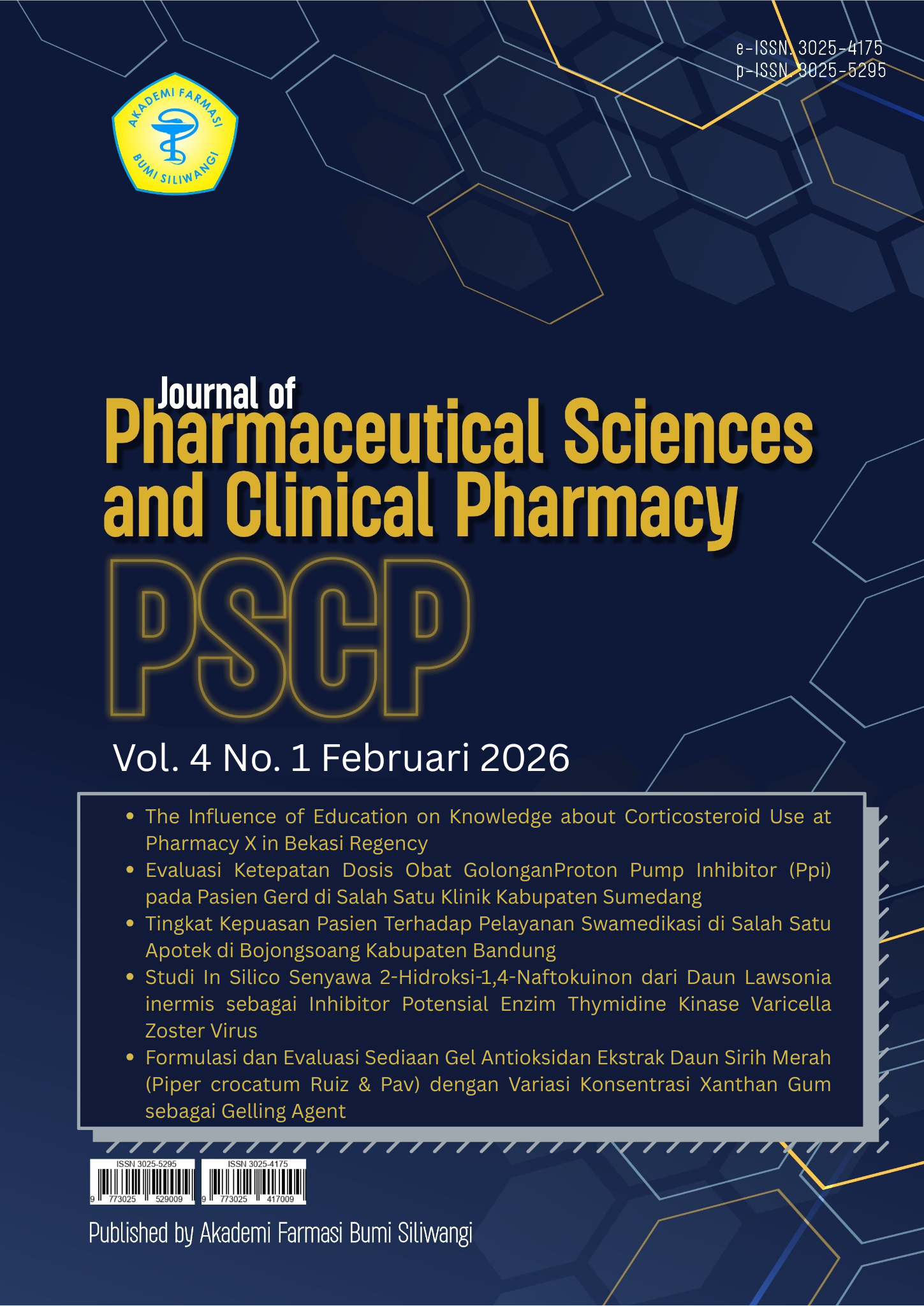
Studi In Silico Senyawa 2-Hidroksi-1,4-Naftokuinon dari Daun Lawsonia inermis sebagai Inhibitor Potensial Enzim Thymidine Kinase Varicella Zoster Virus
DOI:
https://doi.org/10.61329/pscp.v4i1.59Keywords:
Penambatan Molekul, ADMET, Antivirus, Ikatan EnergiAbstract
Lawsonia inermis L. (henna) dikenal secara tradisional di Kalimantan Selatan sebagai tanaman obat untuk perawatan cacar air. Salah satu senyawa bioaktif utama, 2-hidroksi-1,4-naftokuinon (lawsone), memiliki potensi biologis yang luas, termasuk aktivitas antivirus. Penelitian ini bertujuan mengevaluasi potensi lawsone sebagai inhibitor terhadap enzim thymidine kinase (TK) Varicella Zoster Virus (VZV) secara in silico menggunakan pendekatan docking molekuler dan prediksi ADMET. Struktur ligan dan protein diunduh dari PubChem dan PDB, diproses menggunakan AutoDock. Hasil docking menunjukkan bahwa lawsone memiliki energi pengikatan −6,92 kcal/mol dan Ki 8,45 µM, lebih baik dibanding acyclovir (−4,54 kcal/mol; Ki 469,61 µM). Analisis interaksi mengungkapkan ikatan hidrogen, elektrostatik, hidrofobik, dan π–π stacking dengan residu kunci situs aktif, memperkuat stabilitas kompleks. Prediksi ADMET menunjukkan absorpsi usus tinggi (94,28%), permeabilitas Caco-2 baik, penetrasi jaringan luas, volume distribusi lebih besar, serta metabolisme hepatik aman melalui oksidasi/hidroksilasi dan konjugasi fase II. Ekskresi lawsone lebih seimbang dengan clearance rendah, mendukung durasi aksi lebih panjang. Meski sinyal AMES positif dan potensi hepatotoksisitas terdeteksi, validasi eksperimental diperlukan sebelum pra-klinis. Kombinasi afinitas pengikatan tinggi dan profil ADMET yang menjanjikan menempatkan lawsone sebagai kandidat alami potensial untuk pengembangan terapi antivirus terhadap VZV.
Downloads
References
[1] Jeba Sweetly Dharmadhas, Issac Abraham Sybiya Vasantha Packiavathy, Jeyapragash Danaraj SR and AK. Manuscript Info Abstract Introduction : - ISSN : 2320-5407. Int J Adv Res. 2019;7(10):887–96.
[2] Mikhaeil BR, Badria FA, Maatooq GT. Antioxidant and Immunomodulatory Constituents of Henna Leaves. 2004;
[3] Rodrigues M, Manuella X, Silva M, Maise S, Queiroz G, Lima MS De, et al. ( henna ), produces mitochondrial dysfunctions and triggers mitophagy in Saccharomyces cerevisiae. Mol Biol Rep [Internet]. 2019;(0123456789). Available from: https://doi.org/10.1007/s11033-019-05218-3
[4] Xiang S, Li Y, Khan SN, Zhang W, Yuan G, Cui J. Exploiting the Anticancer , Antimicrobial and Antiviral Potential of Naphthoquinone Derivatives : Recent Advances and Future Prospects. 2025;
[5] Li L, Choi W. Heliyon Does prior knowledge increase or decrease perceived visual complexity of texture images ? Heliyon [Internet]. 2023;9(4):e15559. Available from: https://doi.org/10.1016/j.heliyon.2023.e15559
[6] Chen Y, Han M, Zheng Y ying, Zhu F, Aisan A, Maheshati T, et al. Model for End-Stage Liver Disease Score Predicts the Mortality of Patients with Coronary Heart Disease Who Underwent Percutaneous Coronary Intervention. 2021;2021.
[7] Ambrose JM, Kullappan M, Patil S, Alzahrani KJ, Banjer HJ, Qashqari FSI, et al. Inhibitors against Spike Protein of SARS-CoV-2 Wild-Type and Delta Variant : An Integrative in SilicoApproach. 2022;
[8] Eggers J. Dynamics of Liquid Nanojets. 2002;(3):2–5.
[9] Morris GM, Huey R, Lindstrom W, Sanner MF, Belew RK, Goodsell DS, et al. NIH Public Access. 2010;30(16):2785–91.
[10] Morel FMM, Price NM. The Biogeochemical Cycles of Trace Metals. 2012;944(2003).
[11 Navarro-tovar G, Vega-rodr S, Leyva E, Loredo-carrillo S, Loera D De, Itzel L. The Relevance and Insights on 1 , 4-Naphthoquinones as Antimicrobial and Antitumoral Molecules : A Systematic Review. 2023;
[12] Giongo V, Falanga A, Melo CPP De, Silva GB, Bellavita R, De-simone SG, et al. Antiviral Potential of Naphthoquinones Derivatives Encapsulated within Liposomes. 2021;
[13] Papers JBC, Doi M, Bird LE, Ren J, Wright A, Leslie KD, et al. Crystal Structure of Varicella Zoster Virus Thymidine Kinase *. 2003;278(27):24680–7.
[14] Liao Y, Qiu L, Tao A, Li C. Effects of naphthoquinone scaffold-derived compounds on head and neck squamous cell carcinoma based on network pharmacology and molecular docking. 2025;18(4):130–47.
[15] Bobrovs R, Drunka L, Auzins AA, Jaudzems K, Salvalaglio M. Polymorph-Selective Role of Hydrogen Bonding and π − π Stacking in p ‑ Aminobenzoic Acid Solutions. 2021;
[16] Bhalekar MR, Upadhaya PG, Reddy S, Kshirsagar SJ. Formulation and evaluation of acyclovir nanosuspension for enhancement of oral bioavailability. 2014;(June).
[17] Sattar S, Shabbir A, Shahzad M, Akhtar T, Anjum SM, Bourhia M, et al. Evaluation of anti-in fl ammatory and immunomodulatory potential of Lawsone using pre-clinical rodent model of rheumatoid arthritis. 2023;(October):1–11.
[18] Mady OY, Thabit SM, Elnasr SEA, Hedaya AA. An industrial procedure for the intestinal permeability enhancement of acyclovir : in ‑ vitro and histological evidence. Sci Rep [Internet]. 2023;(0123456789):1–15. Available from: https://doi.org/10.1038/s41598-023-47306-2
[19] Kraeling MEK, Bronaugh RL, Jung CT. ABSORPTION OF LAWSONE THROUGH HUMAN SKIN 1. 2007;45–56.
[20] Madaj R, Geoffrey B, Sanker A, Valluri PP. Target2DeNovoDrug : a novel programmatic tool for in silico -deep learning based de novo drug design for any target of interest. J Biomol Struct Dyn [Internet]. 2021;0(0):1–6. Available from: https://doi.org/10.1080/07391102.2021.1898474
[21] Compounds ND like. Predicting the Blood-Brain Barrier Permeability of.
[22] Daina A, Michielin O, Zoete V. SwissADME: A free web tool to evaluate pharmacokinetics, drug-likeness and medicinal chemistry friendliness of small molecules. Sci Rep [Internet]. 2017;7:42717. Available from: https://www.nature.com/articles/srep42717
[23] Kennedy PGE, Mogensen TH, Cohrs RJ. Recent Issues in Varicella ‐ Zoster Virus Latency. 2021;
[24] Osman AM, Noort PCM Van. Evidence for Redox Cycling of Lawsone ( 2- Hydroxy-1 , 4-naphthoquinone ) in the Presence of the Hypoxanthine / Xanthine Oxidase System. 2003;212(January):209–12.
[25] Sauriasari R, Wang D hong, Takemura Y, Tsutsui K, Masuoka N, Sano K, et al. Cytotoxicity of lawsone and cytoprotective activity of antioxidants in catalase mutant Escherichia coli. 2007;235:103–11.
[26] Nair AS, Sekar M, Gan SH, Kumarasamy V, Subramaniyan V, Wu YS, et al. Lawsone Unleashed : A Comprehensive Review on Chemistry , Biosynthesis , and Therapeutic Potentials. 2024;(May):3295–313.
[27] Maillard M, Gong L, Nishii R, Yang JJ, Whirl-carrillo M, Klein TE. PharmGKB summary: Acyclovir/Ganciclovir Pathway. 2023;32(5):201–8.
[28] Bracigliano A, Marretta AL, Guerrera LP, Simioli R, Clemente O, Granata V, et al. The Management of Phaeochromocytomas and Paragangliomas in the Era of Precision Medicine : Where Are We Now ? Evidence-Based Systemic Treatment Options and Future Cluster Oriented Perspectives. 2024;
[29] Kumar M, Kaur P, Chandel M, Singh AP, Jain A, Kaur S. Antioxidant and hepatoprotective potential of Lawsonia inermis L . leaves against 2-acetylaminofluorene induced hepatic damage in male Wistar rats. BMC Complement Altern Med [Internet]. 2017;1–11. Available from: http://dx.doi.org/10.1186/s12906-017-1567-9
[30] Kacirova I, Urinovska R, Sagan J. Biomedicine & Pharmacotherapy Therapeutic monitoring of serum concentrations of acyclovir and its metabolite 9- ( carboxymethoxymethyl ) guanine in routine clinical practice. 2022;156(June).
[31] Pires DE V, Blundell TL, Ascher DB. pkCSM: Predicting small-molecule pharmacokinetic and toxicity properties using graph-based signatures. J Med Chem [Internet]. 2015; Available from: https://pubmed.ncbi.nlm.nih.gov/25409509/
[32] Darvin ASS, Esakkimuthu S, Toppo E. SC. Environ Toxicol Pharmacol [Internet]. 2018; Available from: https://doi.org/10.1016/j.etap.2018.05.006
Downloads
Published
Issue
Section
License
Copyright (c) 2026 Rima Rasida, Rizki Rahmadi Pratama, Muhammad Fauzi, Seno Aulia Ardiansyah

This work is licensed under a Creative Commons Attribution-ShareAlike 4.0 International License.